Parent Guide
What Is Video Self-Modeling?
You already know your child can speak. You've heard it — at home, with you, in the places where they feel completely safe. The problem isn't that their voice is missing. The problem is that their brain has decided certain situations are dangerous, and it shuts speech down before they even have a chance to try.
Video Self-Modeling is a practice tool that works with that biology, not against it. This page explains how — and why it actually works.
What Is Video Self-Modeling?
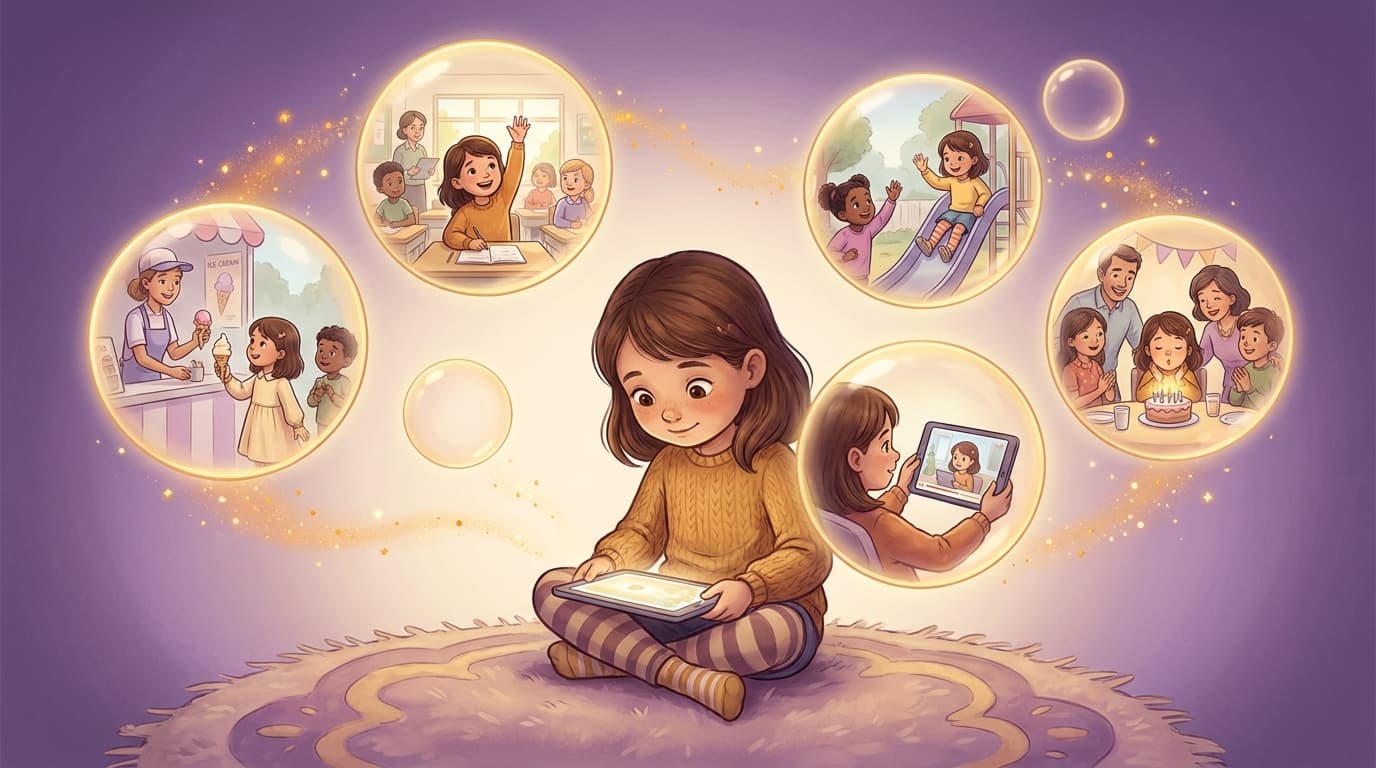
Video Self-Modeling — VSM for short — is a technique where your child watches a short video of themselves successfully doing a speaking moment that normally causes them to freeze.
Here's the key part: the video was recorded at home, in their safe zone, where speaking comes easily. But it's been set up to look like the harder moment — the ice cream counter, the classroom, the birthday party. So when your child watches it back, their brain sees something it has never seen before: themselves, in that situation, speaking.
They watch it multiple times. Each time, the brain takes it in a little more. And over time — not immediately, but gradually — the situation starts to feel less like a threat.
That's it. That's the whole mechanic.
Why It Works: The Science in Plain Language
Your child's brain is not being stubborn. It's doing its job.
Selective Mutism is an anxiety disorder. It is not shyness. It is not defiance. It is not something your child can simply push through if they try hard enough.
What's happening is this: their brain has learned — very effectively — that certain speaking situations are dangerous. That alarm produces a real physical response: throat tightening, freeze, inability to get words out. This is why telling a child with SM to just say it does not work. The speaking skill is there. The alarm is louder.
VSM works by showing the brain new evidence.
The technique is built on a concept called feedforward — the idea is simple. Most feedback tools show a child what they did. VSM does the opposite. It shows the brain what they can do — a future success, not a past attempt.
When your child watches a video of themselves speaking in a scenario that normally causes freezing, the brain gets a message it hasn't received before: I can do this. I already have done this. That message doesn't come from encouragement or praise. It comes from evidence — visual, concrete, undeniable.
Researchers studying this approach believe the brain begins to treat repeated viewing similarly to real experience. The more familiar that success becomes, the less threatening the real moment feels.
Watching more than once is not extra credit. It's the mechanism.
Each time your child watches the video, the brain processes it again. Think of it like a path through the woods. The first time you walk it, the path is barely there. Walk it ten times and it becomes easy to follow. Walk it fifty times and you stop thinking about it at all.
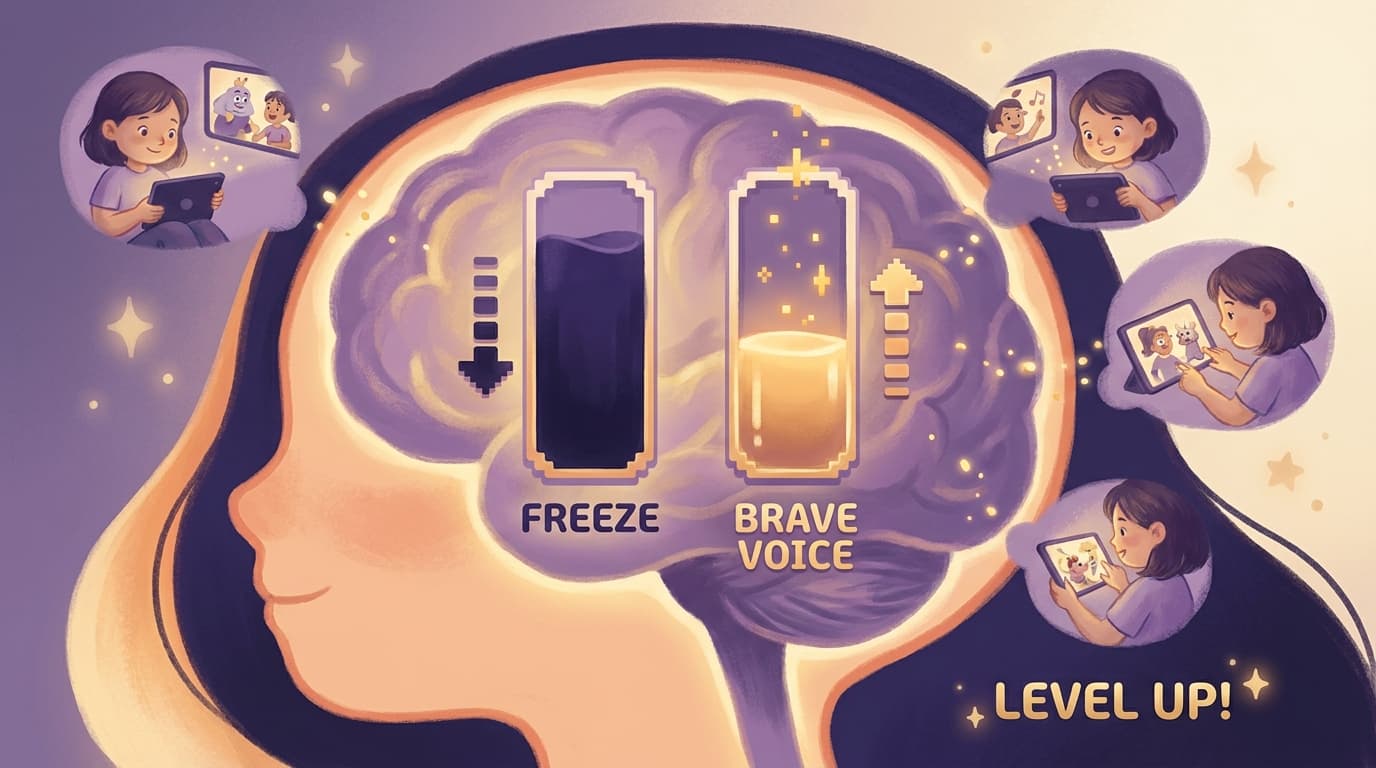
One viewing plants a seed. Repeated viewing is how the root takes hold.
Their brave voice already exists. It just doesn't travel yet.
One of the most frustrating things about SM is that the silence at school is not the same as having no voice. Your child has a brave voice. You've heard it. The problem is that the speaking skills they have at home don't automatically follow them into new settings.
Clinicians call this a stimulus control problem. The skill is real, but it's been attached to one environment — home, comfort, safety. It hasn't yet generalized to harder settings.
VSM helps bridge that gap by building a new kind of home for the skill — a video that looks like the hard setting but was recorded in the safe one. Over time, the gap between home voice and school voice gets smaller.
The research behind this approach
VSM has a research base going back more than 30 years. Researchers including Peter Dowrick and Thomas Buggey have documented meaningful gains in children with SM using this approach — more spontaneous speech, across more settings, sustained over time.
As with many interventions for Selective Mutism — a relatively rare condition that is harder to study at scale — much of this research involves carefully documented individual cases rather than large clinical trials. The patterns across those cases are consistent and encouraging.
BraveVoiceJourney is designed around these VSM principles. We are not the researchers. We've built a tool that makes this clinically supported approach accessible for families to practice between therapy sessions, or alongside a treatment plan.
What It Looks Like in Practice
Step 1: Pick a scenario from the library
BraveVoiceJourney comes with 100+ pre-made scenario videos — short clips of a child or adult asking a question or starting a conversation in a real-world situation. Ice cream shop. Classroom. Birthday party. Playground. You scroll through, find a moment that matches something your child actually faces, and pick it.
Scenarios are organized by difficulty — low, medium, and high challenge — so you can start where your child is today and work up the ladder at their pace. You are not inventing a practice moment. You are choosing from a library built for exactly this.
Step 2: Record your child's response at home
Once you've picked a scenario, the app guides you through recording your child's response — their answer, their greeting, their part of the conversation — right there at home, in the room where their voice comes most easily.
This is the part that makes VSM work: the hard setting is already in the video. Your child doesn't have to be there to record in it. They just have to say their line, at home, where they can.
Step 3: The app puts them together
BraveVoiceJourney merges the two clips — the scenario video and your child's recording — into a single short video. What your child sees when they watch it back is themselves, in the conversation, responding. Not a rehearsal. Not a green screen trick. A finished moment.
That video is theirs to watch as many times as they want, in low-pressure moments, until the scenario starts to feel familiar instead of frightening.
What to Expect Along the Way
- Progress is not a straight line. Your child may do beautifully in a video and still freeze in the real moment. That is not regression. The brain needs time to transfer what it's learned. Keep going.
- Silence on the first recording attempt is not failure. Recording a speaking moment is itself an exposure task. If your child freezes when the phone comes out, start earlier — try audio only, try recording in a different room, try letting them be the one who presses record.
- Fast progress does not mean skip ahead. If your child nails an early brave moment, resist the urge to jump to harder scenarios quickly. Consolidating gains at each step matters. The brave ladder works because each step is built on the last.
- Home practice works best as a bridge, not a replacement. VSM between sessions is most effective when it's connected to what's happening in therapy. The more aligned home practice is with the clinical plan, the more momentum it carries.
- You will be tempted to talk about the video with your child. Asking do you think you can do it now adds pressure to what should be a low-stakes activity. Watch it together, move on, let it do its quiet work.
What a Good First Target Looks Like
A strong first target is brief — one word, one phrase — happens regularly, and is a real moment, not a performance.
- Saying your name to a grandparent over video call
- Asking for a specific item at a drive-through window
- Saying “thank you” when a neighbor gives you something
- Answering “how old are you?” from a familiar adult
If you're not sure where your child sits on the brave ladder, start with whatever they can do successfully at home today. That's your entry point.
FAQs
Is there research behind this approach?
Yes. VSM has been studied for more than 30 years. Researchers Peter Dowrick and Thomas Buggey have specifically documented its use with children with SM, with consistent reports of improved spontaneous speech. Much of this research uses carefully documented individual cases — the standard for studying a condition as rare and variable as SM. BraveVoiceJourney is designed around these VSM principles. The research evidence is for VSM as an approach — not for our specific product.
My child refuses to be recorded. What now?
Start lower. Try audio only. Try recording in a separate room. Try letting them press record. Some children need several sessions of just sitting with the phone nearby before they are ready. That is a legitimate starting point — presence before performance. If your child is in treatment, bring this up with your clinician before trying again.
Does my child need to be in therapy to use this?
They do not need to be — but if your child has recently been diagnosed, or shows signs of SM without an evaluation yet, we strongly encourage connecting with a clinician first. A therapist familiar with SM can help identify the right targets and pace. The Selective Mutism Association maintains a therapist directory at selectivemutism.org. BraveVoiceJourney works best as a bridge between sessions. It is not a substitute for SM treatment.
How long before we see results?
There is no honest answer to how long. Families who practice consistently — daily viewing for two to four weeks before attempting the live moment — tend to see the transition go more smoothly. Progress in SM is rarely a straight line. Small brave moments build on each other.
The video practice seems to be working but the real moment still is not happening. Why?
This usually means the gap between the video scenario and the real scenario is bigger than it looks. Details matter to the anxious brain. Either tighten the match — same setting, same script, same adult if possible — or add an intermediate step. If this pattern persists, bring it to your clinician.
My child was just diagnosed. Where do I even start?
First: you found this page. That matters. SM does not reliably go away on its own. Early support makes a meaningful difference. The most important next step is finding a clinician who knows SM specifically — not all therapists do, and the wrong approach can make things harder. Start at selectivemutism.org. When you are ready, BraveVoiceJourney is here to practice the small brave moments between sessions. You are not behind. You are starting.
Start with one small brave moment.
VSM won't give your child their brave voice. They already have it. What it does is give their brain the evidence it needs to stop treating familiar moments like emergencies.
Start with one small brave moment. Record it at home. Watch it together. Let it do its quiet work.
Start your free practice todayBraveVoiceJourney is designed around video self-modeling principles with a 30+ year research base. It is a practice tool, not a clinical intervention. For diagnosis and treatment, please work with a licensed clinician familiar with Selective Mutism.
Start Here — Free
Try the Voice Map
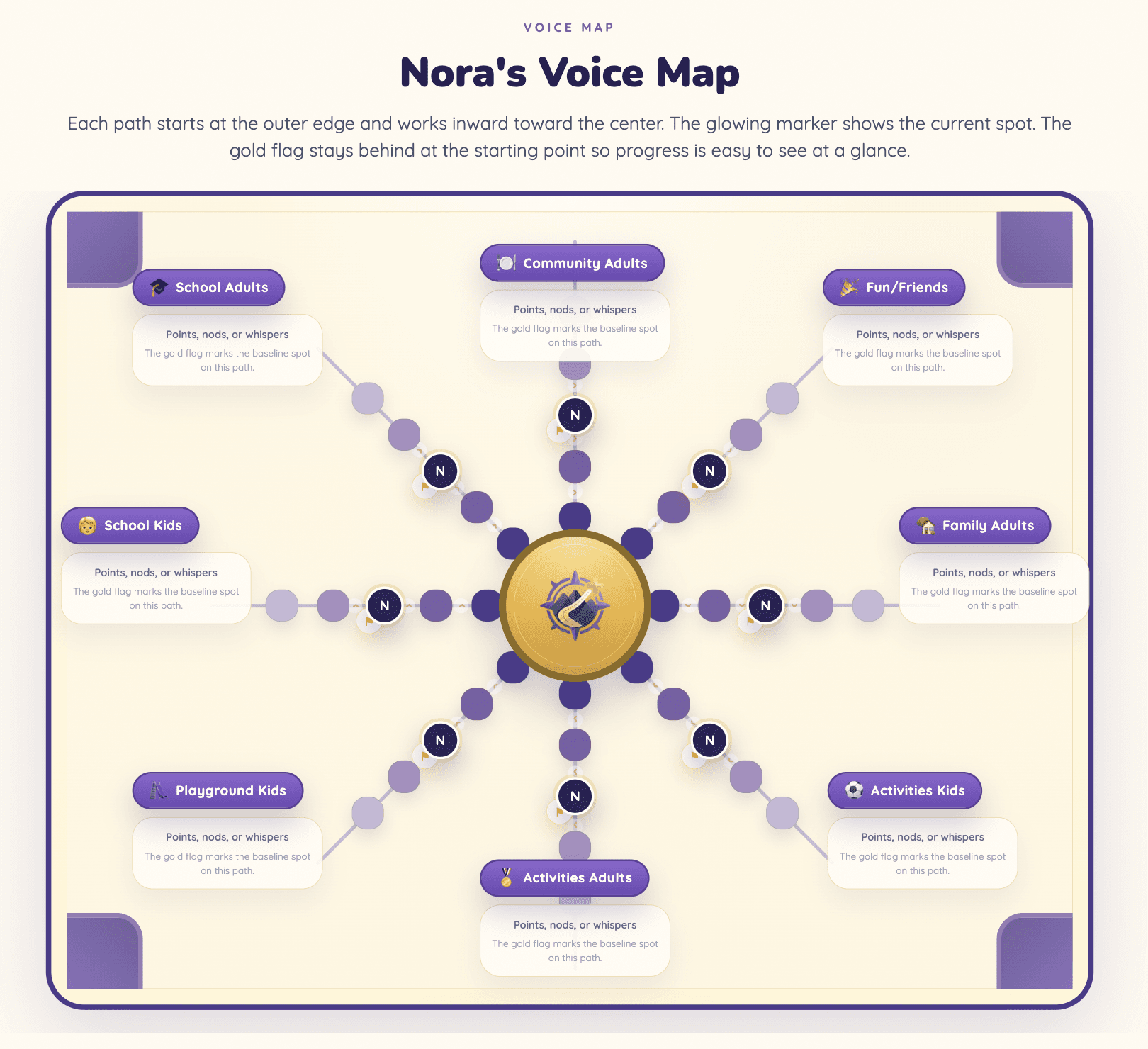
If you're not sure where to begin, begin here. The Voice Map helps parents see where speaking feels easiest, where it gets hard, and which moments are the best place to start. In about 5 minutes, you'll get a clear picture of where your child is right now — and turn "I'm worried something is going on" into a clear next step.
Free to start. Save your child's map and track progress over time.