
Zone 1 — For Preschool Directors and Daycare Owners
You probably have one right now
You probably have one right now. A child who talks freely at home, but has been consistently silent at school long enough that "warming up" doesn't feel like the right explanation anymore.
You've nodded at this child every morning for months. You've had the internal debate about whether to say something to the parents. If a subject line about a child who talks at home but not at school made you open this page, it's probably that child.
This has a name — and it responds to early support
The pattern you're noticing is called selective mutism. It's anxiety-based, not shyness and not stubbornness.
It usually doesn't resolve on its own in the cases that stay consistent month after month. The good news is that early support, especially in the preschool years, is when this pattern is often most responsive.
You do not need to become the diagnostician here. Your job is simpler than that. Notice the pattern accurately, and pass along something helpful.
What this tool does (and what it isn't)
BraveVoiceJourney is a home practice tool built on video self-modeling. The child watches short clips of themselves speaking in situations that currently feel hard, and the practice happens at home, between school days. It is not a clinical replacement. It is not a diagnosis tool. It's structured home practice that gives a family something concrete to do while they figure out next steps. Free to start, no account required.
What forwarding this means — and doesn't mean
Sharing this with a family does not mean you're diagnosing their child or telling them something is wrong. It means you noticed a pattern, you found something that might help, and you're passing it along. That's what good directors do.
If you're a parent who received this link from your child's school —
Someone who knows your child noticed something worth paying attention to. You're in the right place.
Zone 2 — For Parents
What the school noticed (and why it matters)
A child who talks freely at home but goes consistently quiet at school is showing a pattern worth paying attention to. If your preschooler is quiet at school, or your toddler won't talk at daycare, this usually is not about the school doing something wrong and it usually is not ordinary shyness.
It's often anxiety showing up in a specific setting. That pattern has a name, and it responds well to support, especially early.
What video self-modeling is
Your child records herself at home, where she already speaks freely, saying something simple. Then she watches that clip.
Over time, seeing herself successfully move through a moment that currently feels hard builds familiarity with success. She's practicing her brave voice on her own time, in her own space.
It's not magic, and it's not instant. It's repetition building a feeling of, "I've done this before."
How BVJ works
A parent records a short clip at home. The app pairs it with a guided scenario. The child watches it at her own pace. First three videos are free — no credit card, no account, five minutes to get started.
START HERE — FREE
Try the Voice Map
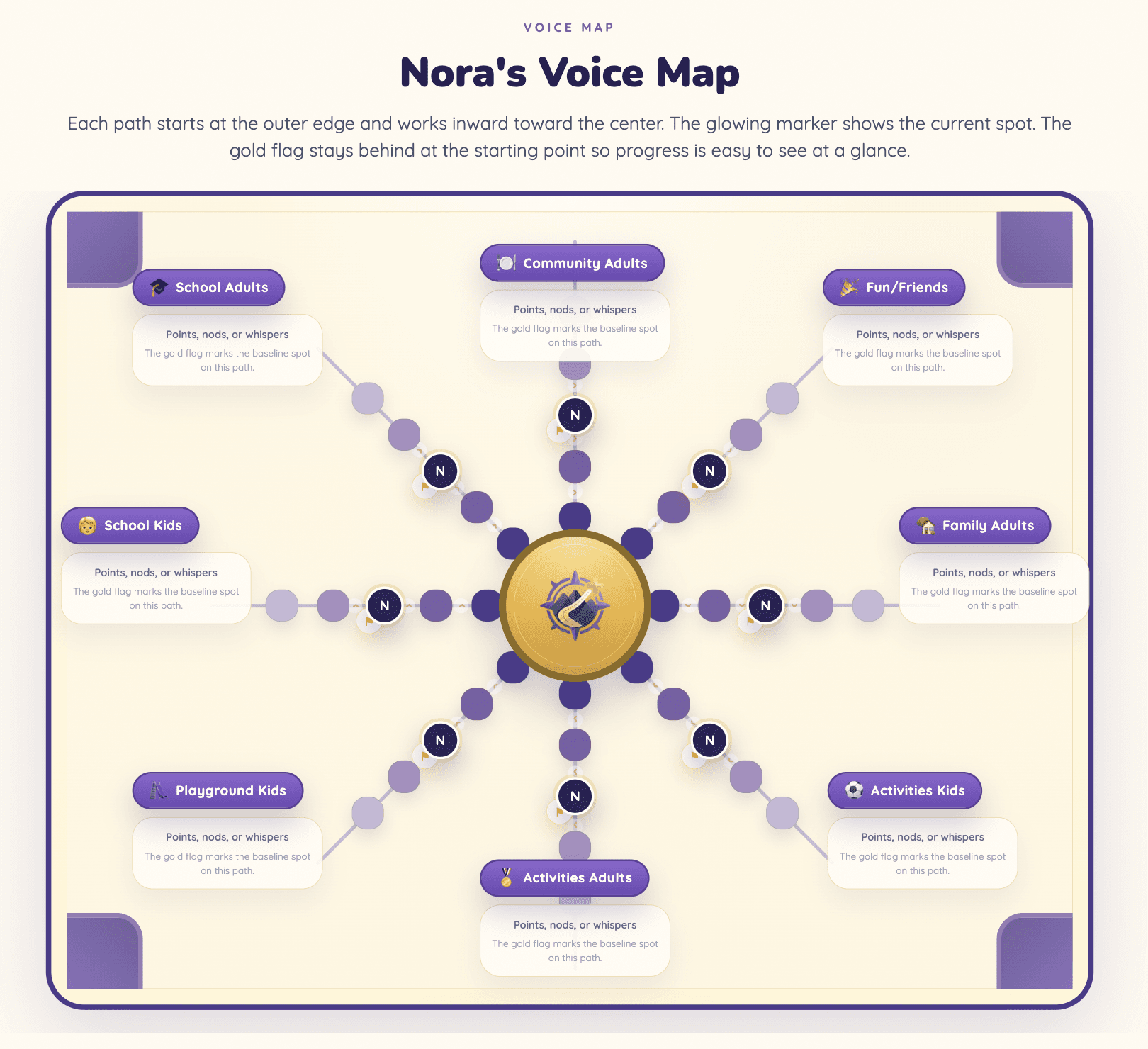
If you're not sure where to begin, begin here. The Voice Map helps parents see where speaking feels easiest, where it gets hard, and which moments are the best place to start. In about 5 minutes, you'll get a clear picture of where your child is right now — and turn "I'm worried something is going on" into a clear next step.
Free to start. Save your child's map and track progress over time.
If this pattern has been consistent for several months, talking with your pediatrician or a speech-language pathologist is a good next step alongside home practice.
A note for teachers and directors
If you're the educator who shared this link, the most useful thing you can do is describe the specific pattern to the parent. Not "she's shy," but "I've noticed she speaks freely on the playground but goes silent during group time, and it's been consistent for a few months."
That specificity is what moves a parent from wondering to acting. For classroom strategies and what to say to families, visit our Teacher Resource page.