

If you've ended up here, my guess is you've spent the last few weeks watching your kid be quieter than the other kids, and you've been trying to figure out whether you should be worried or whether you're being a worried parent.
I get it. We were there. And the answer — the honest, parent-to-parent answer — is: it depends on which kind of "quiet" you're seeing.
Most kids who are described as shy are genuinely fine. Some kids who get called shy are actually working through something more — and the earlier you spot the difference, the smoother the road. The goal of this page is to help you tell which one you're looking at, without rushing you toward a diagnosis you don't need.
I'm Bob. My daughter spent years being labeled "the quiet one" before we figured out what was actually going on. I built BraveVoiceJourney to help other parents skip the years of confusion we went through.
Let's walk through it.
The Quiet Kid Spectrum
It helps to know that "shy" isn't one thing. There's actually a spectrum, and most quiet kids land somewhere on it. Here are the three main spots:
1. Temperamentally shy
The classic shy kid. They're slow to warm up, prefer fewer and closer friendships over big social groups, and might hang back in new situations. But they do engage. Eventually. With a little time and the right setting, they participate, they answer questions, they make friends. Their quietness is a preference, not a barrier.
About 1 in 5 kids land here. It's a temperament, not a problem.
2. Socially anxious
A socially anxious kid is quiet because being around people worries them, not because they prefer quiet. They might avoid eye contact, dread being called on in class, get stomachaches before parties, or refuse to participate in group activities. The quietness has a feeling underneath it — fear, dread, self-consciousness.
This is more than temperament. It's an anxiety pattern that often benefits from support.
3. Selectively mute
A child with selective mutism speaks normally in some settings, almost always home, and is consistently, profoundly silent in others, almost always school. The silence isn't a choice. It's an anxiety-driven freeze response. They literally cannot access their voice in those settings, even when they desperately want to.
Far more common than people realize, and often missed because it gets filed under "shy."
The three categories overlap. A truly socially anxious kid can drift into selective mutism in extreme settings. A temperamentally shy kid can develop social anxiety under enough pressure. The categories aren't a label test — they're a way to figure out where you are right now.
Start Here — Free
Try the Voice Map
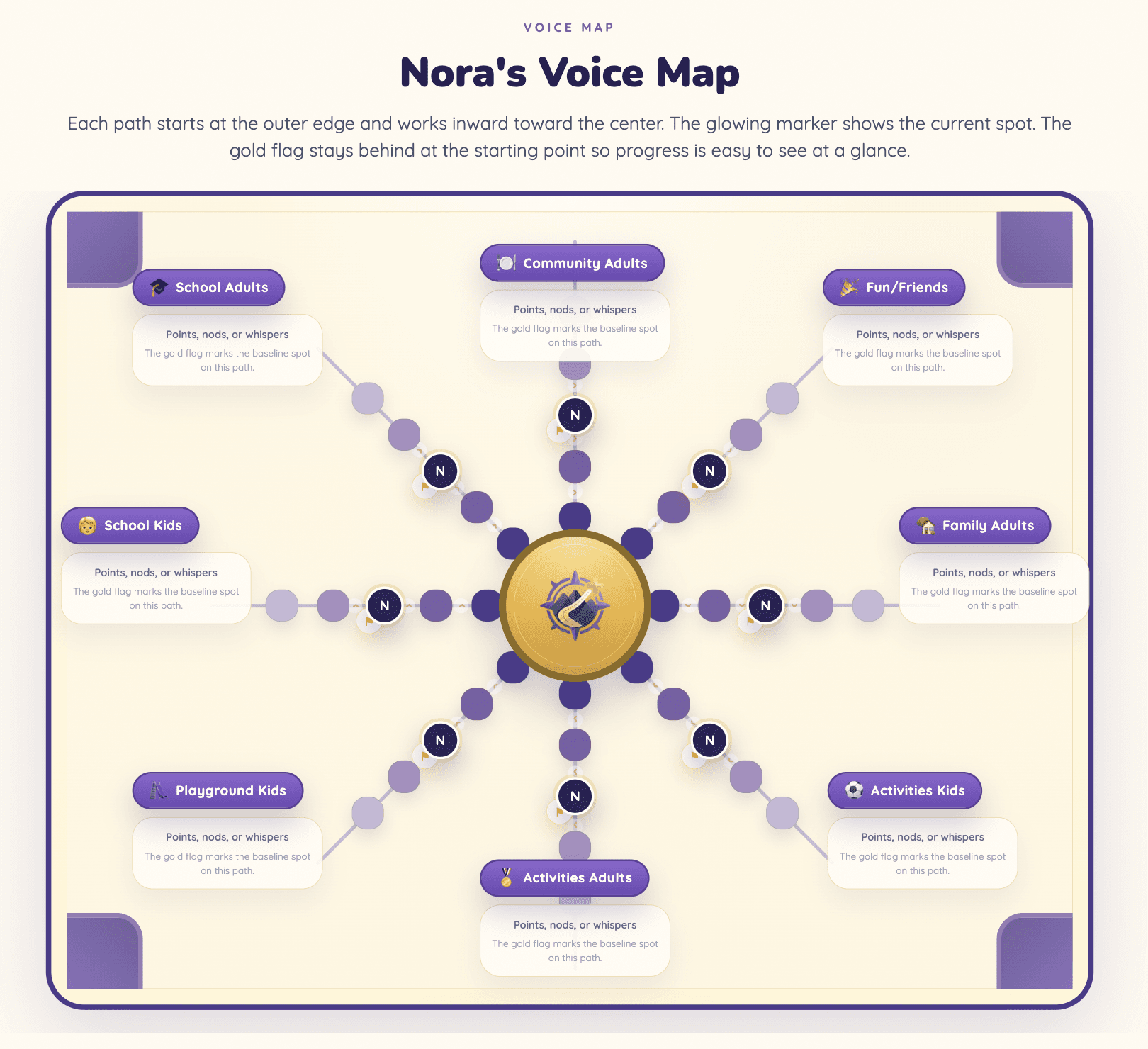
If you're not sure where to begin, begin here. The Voice Map helps parents see where speaking feels easiest, where it gets hard, and which moments are the best place to start. In about 5 minutes, you'll get a clear picture of where your child is right now — and turn "I'm worried something is going on" into a clear next step.
Free to start. Save your child's map and track progress over time.
What "Just Shy" Actually Looks Like
There's a version of "shy" that's totally fine, and it has a few telltale signs:
- They warm up. Maybe slowly, maybe with a single trusted teacher first, but they get there. The trajectory is forward.
- They engage in their own way. Quietly answering a question, raising a hand once or twice, having one or two close friends.
- They can ask for help. Maybe quietly, maybe haltingly, but if they need the bathroom or they got hurt, they can communicate that.
- They speak at normal volume in at least some settings outside the home — a friend's house, the park, the grandparents'.
- They aren't physically distressed when speaking is expected. They might dislike it, but they don't freeze.
If your kid checks most of those boxes, you very likely have a temperamentally shy child, and the most useful thing you can do is take the pressure off them and trust their timing.
Signs It Might Be More Than Shyness
The other end of the spectrum looks different. These are the patterns that suggest you're dealing with anxiety, not just temperament:
- The silence is setting-specific and consistent — almost always school, sometimes also extended family or public places. Not just a bad day.
- They're chatty and expressive at home — often more so than other kids their age. The contrast is dramatic.
- It's been going on for more than a month after they've had time to get used to the setting and the people in it.
- They use non-verbal workarounds: pointing, nodding, whispering only to one trusted friend.
- They look physically frozen when expected to speak — wide-eyed, stiff, struggling with eye contact.
- It's affecting how they function: they can't ask for help, can't ask to use the bathroom, can't make friends, can't participate.
- Their teacher describes them as "the quiet one" or "so well-behaved" — and may not realize the silence is a struggle, not a personality trait.
If three or more of these ring true, you're probably looking at something beyond shyness. That's not a diagnosis — only a professional can give you that — but it's a strong signal that the strategies for shy kids aren't going to be enough on their own.
Where This Falls on the Anxiety Spectrum
If your child is on the more-than-shyness end, the term that's most likely to be relevant is selective mutism. It's worth knowing about even if you're not sure your child has it, because:
- • It's commonly missed. Kids get labeled shy or well-behaved and don't get help until much later.
- • The strategies that help are different from, and gentler than, the ones that help with regular shyness.
- • The earlier you intervene, the better the outcomes.
- • Even if your child doesn't meet criteria for selective mutism, many are dealing with something on the same spectrum.
In plain English: selective mutism is what happens when a child's nervous system perceives a particular setting as so unsafe that the part of them that produces speech goes offline. It's not refusing. It's freezing.
It almost always shows up in the 3–6 age range, almost always becomes most visible at school, and almost always coexists with normal speech at home. If you want to dig into the specific behavior pattern, child won't talk at school but talks at home is the most common entry point.
A Quick Story From Our House
For a long time, "she's just shy" sounded reasonable to us. Our daughter was quiet in new places, liked staying close, and never seemed interested in being the center of attention. Nothing about that felt alarming. Plenty of kids are like that.
The shift came when we started comparing her to other quiet kids and realized the gap was bigger than we had let ourselves admit. Other kids might hang back at first, then answer softly once they felt safe. They might whisper to a teacher, or at least nod and inch their way into the group. Our daughter wasn't doing that. She wasn't warming up. She was freezing.
That was the moment the category changed in my head. We stopped asking, "How do we help a shy kid?" and started asking, "What do we do when a child wants to talk and can't?" That question led us to the term selective mutism, and from there the whole framework changed.
If you want more of our family's story, we wrote that out too.
What to Do, Based on Where You Are
If your child seems temperamentally shy
- • Keep doing what you're doing. Trust their timing.
- • Stop labeling them "shy" out loud — let them define themselves.
- • Reward the bravery moments, not the words.
- • If anything shifts, come back to this page.
If you're somewhere in between
- • Spend the next 2–4 weeks observing rather than fixing.
- • Replace "shy" with more specific descriptions.
- • Start a quick journal: where does the silence get heavy? Where does it lift?
- • If nothing changes in a month, talk to your pediatrician.
If this looks like selective mutism
- • Read child won't talk at school but talks at home. That's our deepest practical guide for this exact pattern.
- • Loop in your child's teacher with a short note.
- • Stop strategies that increase pressure: bribing for words, big public praise, use your words, comparisons to other kids.
- • Get an evaluation if it's been more than two months. Look for someone who specializes in selective mutism specifically.
Frequently Asked Questions
Is shyness a sign of a problem?
Usually not. Temperamental shyness is a normal personality trait that about 1 in 5 kids have. It becomes a concern only when the quietness is preventing your child from functioning — making friends, asking for help, participating — or when it has the physical-freeze quality of anxiety rather than the slow-warmup quality of shyness.
What's the difference between shy and socially anxious?
A shy child prefers quieter, smaller social settings but engages eventually. A socially anxious child wants to engage but feels like they can't — they experience real distress (worry, stomachaches, avoidance) around social situations. The simplest tell: shyness is a preference; social anxiety is a fear.
Can my child grow out of selective mutism on their own?
Some do, but waiting it out without support is a real risk. The longer the silence becomes a habit, the harder it is to interrupt. Many adults with persistent social anxiety trace it back to undiagnosed selective mutism in childhood. Earlier intervention almost always means easier intervention.
At what age should I start being concerned?
The pattern usually becomes visible between ages 3 and 6 — most often when a child starts preschool or kindergarten. Before age 3, quiet in new settings is almost always normal. After about a month into a new school setting, persistent silence is worth paying attention to.
Is being shy genetic?
Temperament is partly genetic — kids who are wired toward higher behavioral inhibition are more likely to be shy and slightly more likely to develop anxiety later. But genetics aren't destiny. Environment and parenting strategies matter a lot.
Does pushing my shy child to talk help?
No, and this is one of the most counterintuitive truths about quiet kids. Pressure raises anxiety. Anxiety deepens silence. Across the entire spectrum — from mildly shy to fully selectively mute — taking the pressure off speech and rewarding bravery rather than words is what creates the conditions for speech to come back.
My pediatrician said "she'll grow out of it." Is that true?
Sometimes. But pediatricians often aren't trained to spot selective mutism specifically — it falls between speech-language pathology and child psychology. If your gut is telling you something more is going on, trust your gut. A second opinion from someone who specializes in childhood anxiety is worth the appointment.
You don't need a diagnosis to start helping your child today. You just need a clearer picture of what you're looking at. Wherever your kid lands on the spectrum — fully shy, fully selectively mute, or somewhere in between — the same broad principles apply: take the pressure off, reward the bravery, and trust the long arc. The kids who get there are the kids whose parents stayed patient and stayed curious. You're already doing that, or you wouldn't be on this page.
Start Here — Free
Try the Voice Map
If you're not sure where to begin, begin here. The Voice Map helps parents see where speaking feels easiest, where it gets hard, and which moments are the best place to start. In about 5 minutes, you'll get a clear picture of where your child is right now — and turn "I'm worried something is going on" into a clear next step.
Free to start. Save your child's map and track progress over time.
Related Reading
Why your child talks at home but not at school
The clearest next step when the home-versus-school contrast is the thing you cannot unsee.
My preschooler won't talk at school
The best next read when you are seeing the pattern in a 3–5 year old and want preschool-specific guidance.
My kindergartner won't speak in class
The next place to go when the pattern becomes more visible under kindergarten-level classroom demands.
Why your child won't talk to their teacher
When the adult relationship is the hardest part of the school day.
My child won't talk to grandparents or relatives
The family-event version of the freeze pattern, and how to coach relatives gently.
When does shyness become a problem?
A cleaner decision framework for knowing when to keep watching and when to act.
What it means when your child whispers at school
Whispering can be progress or a plateau. This page explains how to tell.
Read our family's story
More of Bob's family story, plus the milestones that made progress easier to recognize.