The Brave Ladder: A Parent's Guide to Exposure Practice for Selective Mutism
Your child is not being difficult. They are not choosing silence to frustrate you. And they are not going to simply grow out of this on their own.
What you are watching is anxiety at work — deep, automatic, and real. The good news is that anxiety responds to a specific kind of practice. Not pressure. Not pep talks. Gradual, structured, brave-enough steps, taken in the right order.
That is what the exposure ladder is for. And this page will show you how to build one.
What Is the Exposure Ladder?
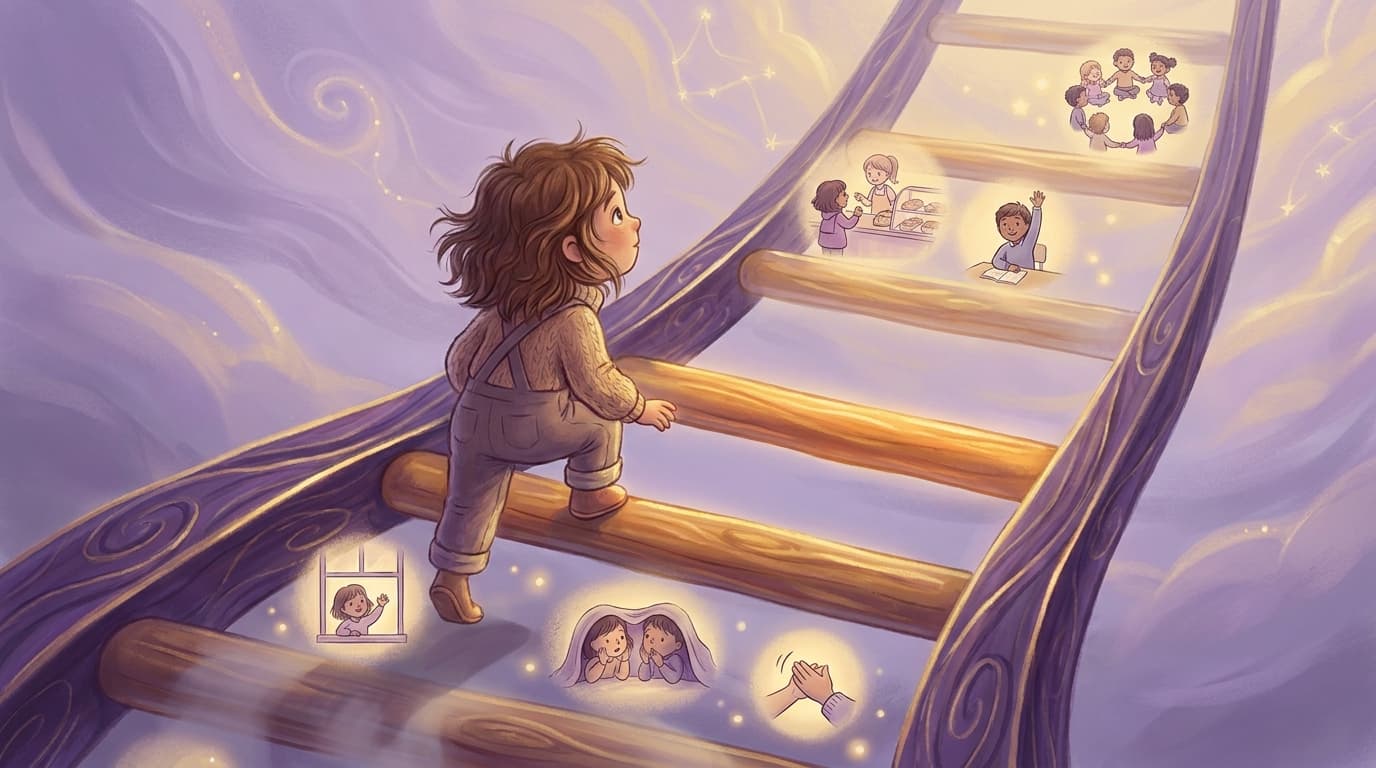
The exposure ladder — or "brave ladder" as we call it — is a structured approach to helping children with anxiety face difficult situations step by step.
Here is how it works in plain language:
You start at the bottom, with things your child can already do. Then you move up, one rung at a time, toward harder situations. You only move to the next rung when the current one feels manageable — not effortless, but manageable.
That's it. Small steps. In order. One at a time.
The ladder is not a race. There is no finish line you need to reach by next month. A child who moves up one rung and holds it there for two weeks has made real progress. A child who moves from complete silence at school to whispering an answer to a trusted teacher has crossed a distance that most people cannot fully appreciate.
The exposure ladder is among the most evidence-based approaches in anxiety treatment. It is widely used by child psychologists and speech-language pathologists, and specifically effective for Selective Mutism.
Why It Works
The Avoidance Loop
When your child's brain senses a speaking situation, it sends an alarm signal. Danger. Threat. The freeze response kicks in.
Your child goes silent. The moment passes. The alarm stops.
Here is the problem: the brain files that away as a lesson. "Silence worked. Silence is safe. Do it again next time."
Every time your child avoids a speaking situation — or is rescued from one — the alarm gets a little stronger. The brain becomes more convinced that speaking in that setting is genuinely dangerous. The freeze gets easier, not harder.
This is not a character flaw. It is how anxiety works in every human brain. Your child is not being difficult. They are doing exactly what their brain has been trained to do.
The Approach Loop
The exposure ladder breaks that cycle by doing the opposite.
Instead of avoiding the situation, your child approaches it — at a level that is just manageable. Not easy. Just manageable.
When they approach the situation and the catastrophe doesn't happen, the brain files a different lesson: "I stayed. Nothing terrible occurred. Maybe I can try again."
Over time, with repeated brave moments at each rung, the alarm signal gets quieter. The brain starts to learn that the speaking situation is not actually dangerous. The freeze has less grip.
This process takes time. It is not fast. But for most children who work through graduated exposure consistently, it is reliable — because you are working with how the brain actually learns, not against it.
One Critical Rule
Going too fast backfires.
If your child is pushed up the ladder before they are ready, the alarm gets louder, not quieter. They may slide back further than where they started. A child who was ordering ice cream with a whisper may refuse to enter the shop at all.
The ladder only works when the pace belongs to the child. Your job is to hold the structure, not to accelerate the timeline.
How to Build Your Child's Brave Ladder
Every brave ladder is personal. A rung that is easy for one child with SM may be genuinely impossible for another. You are not copying a generic list — you are mapping your child's specific anxiety landscape.
Here is how to do it.
Step 1: Draw Your Child's Speaking Map
Before you build rungs, you need to know what your child can already do.
Sit down and map it out:
- Who does your child talk to, without hesitation? (Usually immediate family, sometimes one or two close friends)
- Where do they talk? (Home? Grandparent's house? Car?)
- What conditions make it easier? (One-on-one vs. group? Familiar adults vs. strangers? When they initiated vs. when they were asked?)
- What conditions make it harder? (Unexpected questions? Being watched by multiple people? Louder environments?)
This speaking map becomes the foundation of your ladder. The bottom rungs live inside your child's current comfort zone. The top rungs are the situations that currently feel impossible.
Step 2: Identify the Rungs
Rungs are situations that are slightly harder than what your child can already do.
The key word is slightly. Not dramatically. Not "let's try the school lunch line." Slightly.
Ask yourself: "Is there a version of this that's just a little bit harder than what they can do today?"
A few examples of how to find the next rung:
- Same setting, slightly less familiar person (talking to a neighbor instead of a family friend)
- Same person, slightly less controlled setting (answering a question at a restaurant table instead of at home)
- Same setting, slightly more witnesses (whispering to a teacher when one other student is nearby, instead of when the room is empty)
- Same situation, different communication (mouthing the word instead of saying it; pointing instead of mouthing)
Non-verbal responses are real rungs. Pointing. Nodding. Handing over a written note. Mouthing a word without sound. These are not failures or consolation prizes. They are legitimate steps in the approach process. Make sure your child knows that these count.
Step 3: Order the Rungs From Low to High
Once you have a list of situations, sort them from least scary to most scary. Ask your child to help rank them if they are able. Children often have a clearer sense of their own hierarchy than parents expect.
Here is a rough example of what a brave ladder might look like for a school-age child with SM:
| Rung | Situation | Challenge Level |
|---|---|---|
| 1 | Answers a question at home with parent, no one watching | Basecamp |
| 2 | Waves or nods hello to a neighbor outside | Very Low |
| 3 | Points to an item when ordering with parent nearby | Low |
| 4 | Mouths “thank you” to a store clerk | Low–Medium |
| 5 | Whispers an answer to a familiar teacher, one-on-one | Medium |
| 6 | Says their name when prompted by a known adult, small group | Medium–High |
| 7 | Orders a food item at a counter, with parent standing back | High |
Your child's ladder will look different from this one. That is correct. Use this as a template, not a prescription.
Step 4: Know When to Move Up
The rule is simple: when a rung feels manageable — not easy, manageable — with reasonable consistency, it is time to try the next one.
"Reasonable consistency" means: your child can approach this situation most of the time without significant distress. Not every time. Not without any nerves. Most of the time.
If you move to the next rung and see significant regression — refusal, meltdowns, pulling back on rungs they had already mastered — you have moved too fast. Go back. Consolidate.
Progress is not a straight line. Two steps forward and one step back is still progress.
Start Here — Free
Try the Voice Map
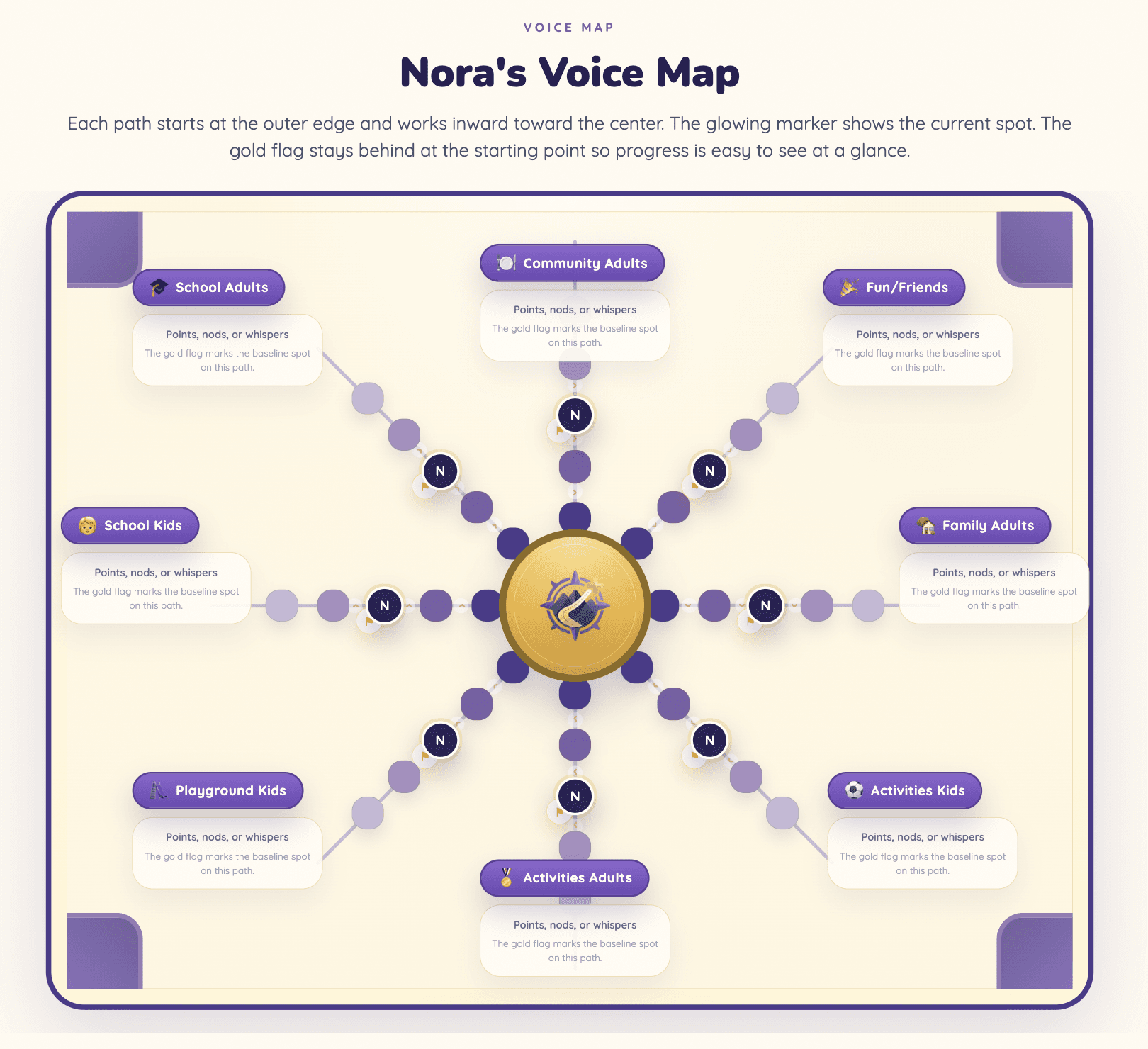
If you're not sure where to begin, begin here. The Voice Map helps parents see where speaking feels easiest, where it gets hard, and which moments are the best place to start. In about 5 minutes, you'll get a clear picture of where your child is right now — and turn "I'm worried something is going on" into a clear next step.
Free to start. Save your child's map and track progress over time.
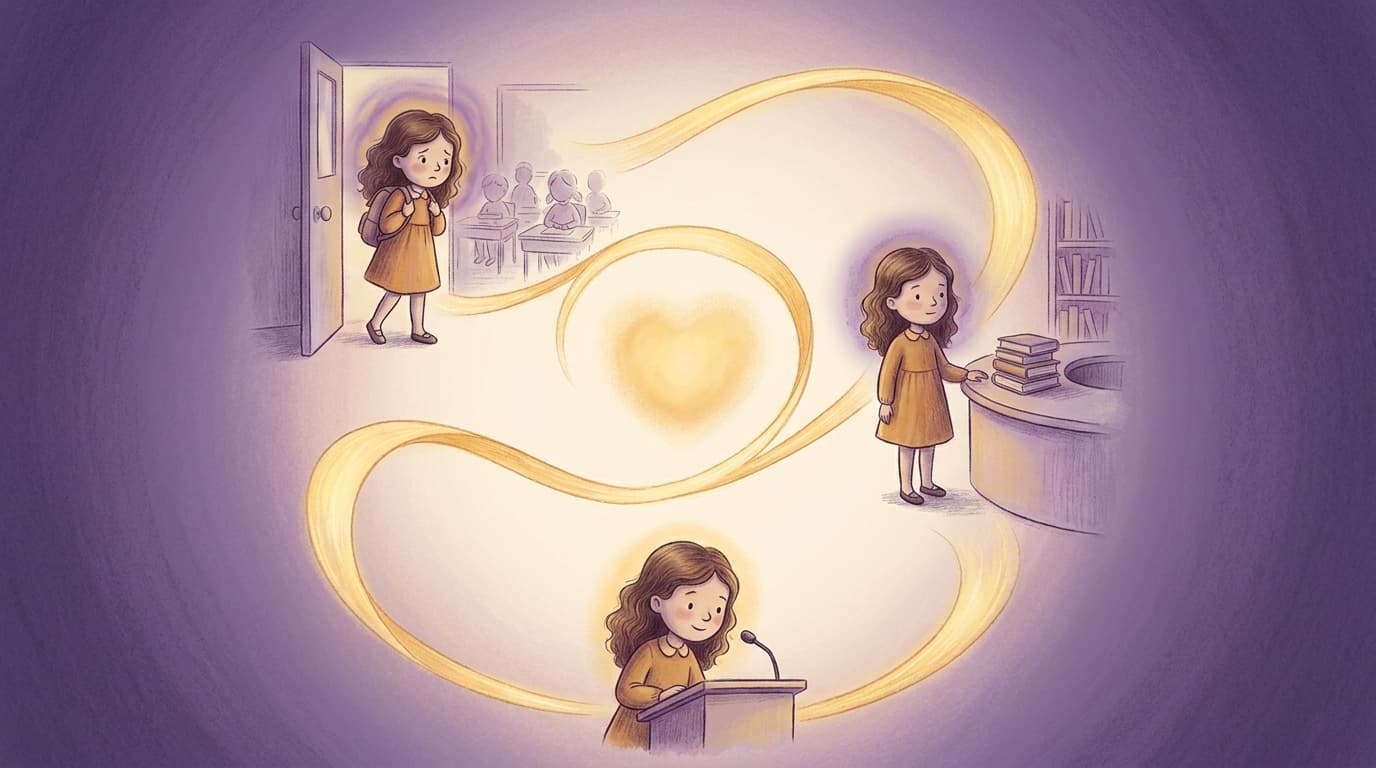
How BraveVoiceJourney Fits In
Building a brave ladder tells you what to work on. But knowing what to work on and being able to attempt it are two different things.
This is where video self-modeling comes in.
VSM Is the Bridge
Video self-modeling (VSM) is a technique where a child watches a video of themselves successfully navigating a situation that normally triggers freezing. Researchers including Peter Dowrick and Thomas Buggey have documented meaningful gains in children with SM using this approach. Much of this research involves carefully documented individual cases — the standard for studying a condition as rare and variable as SM. The patterns across those cases are consistent and encouraging.
Researchers studying this approach believe the brain begins to treat repeated self-model viewing as familiar experience — a kind of memory of success in a situation that previously felt impossible. Over time, the successful moment in the video begins to feel familiar rather than threatening. The freeze has less to grip onto.
BraveVoiceJourney is built around this technique.
How BVJ Maps Onto the Ladder
BVJ has a library of 100+ guided scenario videos — pre-made scenes from real-world settings like restaurants, classrooms, playgrounds, and birthday parties. These scenarios are organized by difficulty:
- Low Challenge — Familiar settings, low-stakes moments, minimal social complexity
- Medium Challenge — Semi-public settings, slightly more unpredictable interactions
- High Challenge — Spotlight moments, unfamiliar people, higher social stakes
This maps directly onto the brave ladder. You do not have to invent scenarios. You look at where your child is on the ladder, find the matching tier in BVJ, and start there.
The workflow is straightforward:
- Identify the rung your child is working on
- Find a BVJ scenario that matches that difficulty level
- Your child records their response at home — in their safe zone, at their pace
- The app assembles a VSM video: your child watching themselves succeed in that moment
- Watch the video repeatedly before attempting the live version of that rung
The video is not a replacement for the live attempt. The brave moment still has to happen in real life. VSM reduces the alarm signal before the attempt — it is the bridge, not the destination.
If you are working with a therapist, ask them which scenarios to prioritize and when to schedule the live attempts. The right pairing between VSM practice and live exposure matters, and a clinician can help calibrate it.
What to Expect Along the Way
Progress is not a straight line. Your child will have weeks where they move up two rungs. They will have weeks where they slide back. Both are normal. What you are watching for is the general direction over months, not the result of any single attempt.
Regression is information, not failure. When a child slides back, the nervous system is telling you something. Usually it means the previous rung was not fully consolidated, the pace was too fast, or something changed in the child's life that raised their baseline anxiety. Go back to a lower rung, let your child have some easy wins, and rebuild from there.
"Stuck" looks different from "slow." Slow means gradual movement you can see over weeks, even if each shift is tiny. Stuck means no movement at all, over multiple weeks, at a rung that is not unusually hard. When you see genuine stuck — not slow, but stuck — that is the right time to consult a clinician who specializes in SM if you are not already working with one.
Home practice works best alongside clinical support for more complex cases. For children with mild to moderate SM who are making some progress, parents can often manage the ladder at home with good information and consistent effort. For more severe SM, a licensed clinician familiar with SM should be involved in building and pacing the hierarchy. BVJ is designed to complement clinical treatment. If your child has not been evaluated, the Selective Mutism Association maintains a therapist directory at selectivemutism.org.
A note on parent accommodation. This one is hard to hear, so I'll say it gently: the things we do to protect our children from anxiety can sometimes make the anxiety stronger over time. Speaking for your child when they freeze. Avoiding situations where they might be asked to talk. These moves come from love. But the brain files them as confirmation that the situation was, in fact, dangerous — and that escape was the right move.
This is called accommodation, and it is one of the most common patterns in families living with SM. You have not caused this. And you can change it. The goal is not to withdraw support suddenly — it is to gradually shift from protecting your child from the alarm to standing alongside them while they face it. That is exactly what the brave ladder helps you do.
Frequently Asked Questions
What's the difference between the brave ladder and just pushing my child?
Pushing means asking your child to attempt something before they are ready — several steps above where they are, with no preparation, often under time pressure. The ladder is the opposite.
The ladder starts below your child's current ability. It builds incrementally. It gives your child agency over the pace. And it treats every approach — even a nod, even walking toward the counter — as a win, regardless of whether speech happened. Pushing increases the alarm. The ladder teaches the brain that approaching is survivable.
My child is stuck on the same rung for weeks. What do I do?
First, check whether the rung is actually too hard. Try breaking it into smaller pieces. Second, use BVJ video practice more intensively before the live attempt — daily viewing for one to two weeks before trying the rung again. If nothing shifts over four to six weeks, bring in a clinician. Stuck is a signal, not a character trait. An SM specialist can usually identify what is blocking forward movement when a parent cannot see it from inside.
Do non-verbal responses count?
Yes. Fully and completely.
A nod counts. A point counts. Mouthing a word without sound counts. Handing a written note counts. Eye contact and a smile when spoken to counts.
Non-verbal responses are approach behaviors. The brain is learning that this situation is survivable — and that is the entire mechanism of the ladder. Do not let anyone dismiss these as not trying. They are trying. They are doing exactly what the brave ladder asks them to do.
Should I build this ladder on my own or with a clinician?
It depends on where your child is.
If your child has mild SM and is making some progress, building a home ladder and using BVJ for practice is a reasonable starting point. If your child has moderate to severe SM, has been stuck for an extended period, or has significant distress in multiple settings, please involve a clinician before building and implementing a hierarchy. A poorly sequenced ladder can cause regression that takes months to recover from. An SM-specialized SLP or child psychologist can assess where your child is, sequence the hierarchy correctly, and help you avoid pacing errors.
How does BVJ connect to the ladder?
BVJ's scenario library is organized by difficulty tier — Low, Medium, and High Challenge — which maps directly onto the brave ladder. Once you identify which rung your child is working on, you find a matching scenario, have your child record their response at home, and the app assembles a self-model video they can watch repeatedly.
That video becomes the bridge between practiced it at home and tried it in real life. It does not replace the live attempt — it prepares the brain for it by making the successful version feel familiar before the real moment arrives.
Start Here — Free
Try the Voice Map
If you're not sure where to begin, begin here. The Voice Map helps parents see where speaking feels easiest, where it gets hard, and which moments are the best place to start. In about 5 minutes, you'll get a clear picture of where your child is right now — and turn "I'm worried something is going on" into a clear next step.
Free to start. Save your child's map and track progress over time.