

If you're sitting here Googling some version of my preschooler won't talk at school at 9pm tonight, I want to start by saying: you're not overreacting, and you're not late.
You probably had at least one moment in the last few weeks where you stood in the preschool drop-off line, watched your kid clamp down the second a teacher made eye contact, and thought — something is going on here that the other parents don't seem to be dealing with.
You're right. Something is.
The good news: it has a name, it's more common than people realize, and the fact that you're paying attention to it now — while your child is still in preschool — puts you in the best possible position to help. Most parents don't notice this until their kid is already deep into kindergarten or first grade.
I'm Bob. My daughter spent her preschool years almost completely silent at school. We didn't have a name for what we were seeing for a long time. I built BraveVoiceJourney so that other parents could skip ahead a year or two of confusion. Let's get into it.
What's Actually Happening When Your Preschooler Won't Talk at School
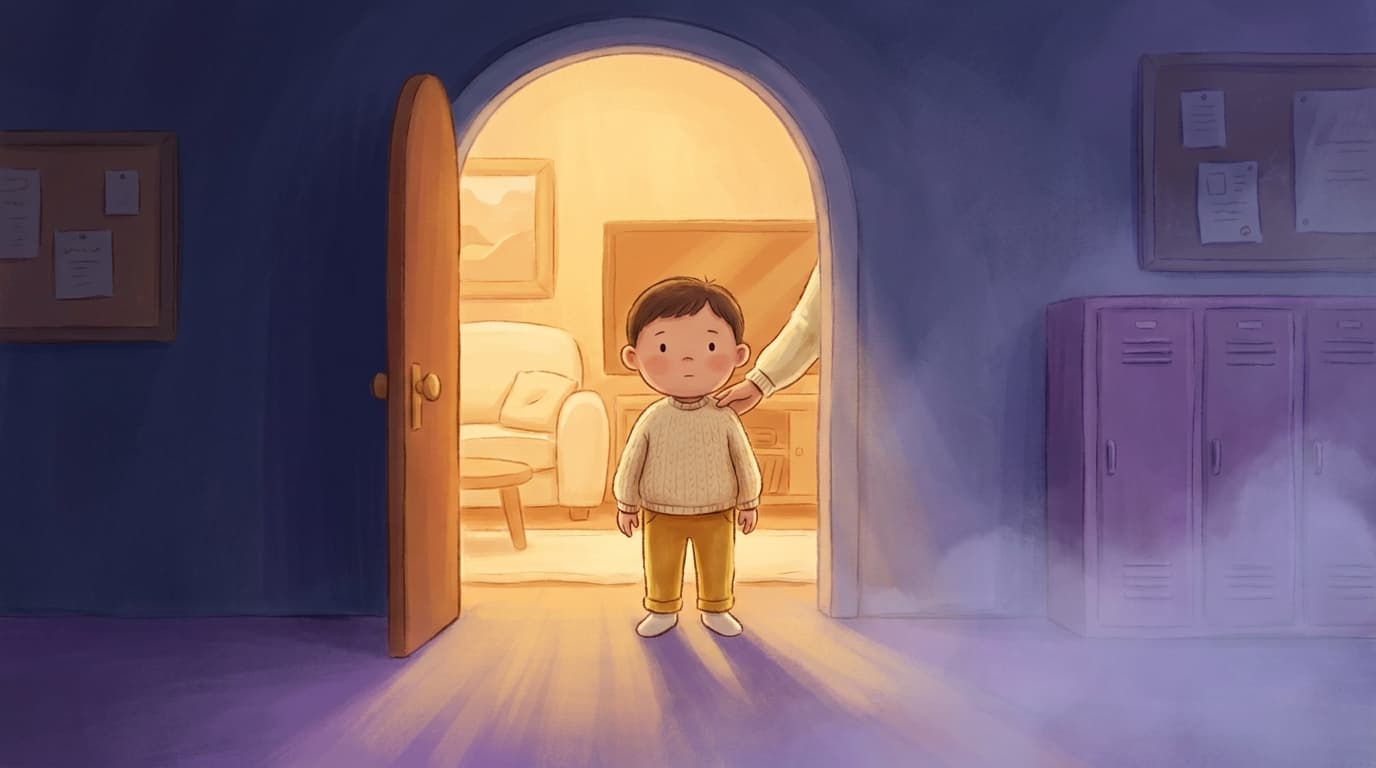
When a preschooler chatters non-stop at home but goes silent the second they walk into the classroom, it's almost never about being a slow warmer or needing more time to adjust. Those things are real, but they show up as a slow ramp from quiet to engaged over a few weeks. Not as a months-long brick wall.
What's typically happening when a preschooler stays consistently silent at school is anxiety. Not the kind of anxiety adults experience around deadlines — a more primal, body-level version. Their nervous system has filed speaking at school as something dangerous, and the part of them that produces speech essentially goes offline when they cross that threshold.
It's not a choice. They aren't refusing. They're frozen.
The clinical name for the more pronounced version of this is selective mutism — and the name is genuinely misleading. Your child isn't selecting anything. The mutism is selective in where it shows up, not in any willful sense.
The 3–5 age range is when this pattern most often becomes visible, because preschool is most kids' first sustained exposure to a setting outside the home where they're expected to speak with strangers. If this is what you're seeing, you're not catching it late. You're catching it at the exact right moment to do something about it.
First — Is This Just Adjustment, or Something More?
A few weeks of quiet at the start of preschool is normal. So is the kid who takes a month before raising their hand. The pattern below is what tends to point past adjustment and toward something deeper:

- It's been more than 4–6 weeks since they started, and the silence has not budged at all — not still mostly quiet, but actually no words spoken to teachers or peers.
- They're chatty and animated at home, including talking about preschool — friends, teachers, what happened at snack time. The contrast is dramatic.
- They use non-verbal workarounds at school: pointing at the snack they want, nodding when asked yes/no questions, sometimes whispering only to one trusted friend.
- They look physically frozen when expected to speak — wide eyes, body stiffened, sometimes appearing not to hear.
- They can't ask for help — including for the bathroom, water, or telling a teacher they got hurt.
- They aren't participating in preschool rituals — circle time, sing-along, name greetings, show-and-tell. Other kids do these without thinking. Yours sits silently outside of them.
- The teacher describes them as well-behaved or the quiet one — and may not realize the silence is a struggle, not a personality trait.
- They show reluctance to go to school they can't quite explain — drop-off resistance, stomachaches, asking to stay home.
If three or more of those ring true, you're probably not dealing with adjustment-period quiet. You're looking at something that needs a different approach than give them time.
If your preschooler is showing the dramatic gap between home and school specifically, our deepest guide on that pattern lives at talks at home but not at school. And if you're earlier in the worry — not sure whether this is shyness, anxiety, or something more — start with our hub page on is my child just shy or something more.
What Helps (and What Makes It Worse)
This is the part I wish someone had handed me when my daughter was four. A lot of the things that feel helpful at preschool drop-off actually deepen the silence. And a lot of what works feels counterintuitive at first.
What makes it worse
Even when it feels right
- • Pressuring them to say hi at drop-off. Drop-off is already the highest-anxiety moment of the day. Adding a speech demand on top of it is like asking a freezing kid to do a math problem.
- • Making a huge deal when they do speak. Suddenly all eyes are on them, and the next time they consider speaking, it feels like a performance.
- • Bribing or rewarding for words. Now speech has stakes. Stakes increase pressure. Pressure increases freezing.
- • Comparing them to siblings or other preschoolers. Adds shame on top of anxiety.
- • Speaking for them in every interaction. Tempting, but it teaches them that silence works.
- • Calling them shy in front of them. Labels stick at this age, fast.
- • Treating preschool like something they can opt out of. Pulling them out of class might feel kind in the moment, but exposure without pressure is part of the long-term path.
What actually helps
The lower-pressure path
- • Take the pressure off speech entirely. At drop-off, just hand them off with warmth and walk. No say bye to the teacher. Your job in those moments is to lower their anxiety, not extract words.
- • Loop in the preschool teacher early. Most preschool teachers genuinely want to help and have seen this before. A short note explaining what you see at home is one of the most effective things you can do this week.
- • Praise the bravery underneath, not the words. You walked into class on your own today. That was huge.
- • Build a talking ladder. Start where they can speak and add gentle steps from there.
- • Let them communicate however they can — pointing, nodding, whispering, drawing. Bridges first. Sentences later.
- • Don't pull them from preschool. Keep them going. Exposure without pressure is part of the path.
- • Get an evaluation if it's been more than 8 weeks of consistent silence. A speech-language pathologist or child psychologist who specializes in selective mutism is the gold standard.
- • Trust the long arc. Almost every preschooler who gets the right kind of support eventually finds their voice. Mine did. Yours can too.
See what video self-modeling looks like for your child
This is exactly what we built BraveVoiceJourney for. Your child watches a short, edited video of themselves successfully doing the thing that's hard right now - answering the teacher, ordering at a counter, saying their name - and over time, that helps their brain unfreeze the moment in real life.
Try a practice video for free. No credit card needed.
Try a Free Practice Video >A Quick Story From Our House
This is the moment — well before any diagnosis — when the worry first sat down hard in my chest.
Some close friends of ours host a big backyard cookout every summer. The works: grill smoke, twenty-something kids tearing across the lawn, a slip-and-slide running for hours. The kind of day a 4-year-old should be living for.
Both of our girls clung to my legs when we got there. One of them, the one this whole site is really about, did so with a particular kind of stillness.
She watched. For hours. She watched the other kids slide and shriek and run back up to do it again, and again, and again. She didn't move toward the lawn. She didn't speak to anyone. Not the kids she'd known her whole life. Not the parents she'd seen a hundred times. She was a small, silent statue at my hip while the entire cookout happened in front of her.
The part that sits with me even now: it wasn't until late in the afternoon — after most of the other kids had moved on to something else and the slip-and-slide was nearly empty — that she finally, with a long runway of encouragement from us, agreed to try it. By the time she was sliding, the party was nearly over. The thing she'd watched for hours had been hers to enjoy for fifteen minutes at the end.
We didn't know what to call any of this yet. She wasn't being a brat. She wasn't sulking. She was, in some sense we couldn't articulate at the time, waiting for permission — from her own nervous system — to do something every other kid in the yard had done without thinking about it.
It wasn't shyness. Shy kids hang back, then wade in. She was somewhere else entirely. Doing the math on how much risk participating might cost her.
It would be a long while before we had a name for what we were seeing. But that backyard cookout is the day I first knew something was different. If you want more of our family's story, we wrote that out too.
What to Do This Week
If you've read this far, you're probably ready to do something — not next month, this week. Three small steps that don't require a diagnosis or even any certainty about what's going on:

- 1. Stop saying shy. Replace it with still warming up or just stop labeling altogether. The label is sticky at this age, and it tends to do more harm than good. Tonight.
- 2. Send a short note to the preschool teacher. Something like: I wanted to share that [child's name] talks easily at home but tends to freeze up when speaking is expected at school. We're working on it. The most helpful thing is to take pressure off speaking, give her time, and let her communicate however she can — pointing, nodding, whispering to a friend. Please don't ask her to speak in front of the class or single her out. I'd love to compare notes on what you're seeing.
- 3. Watch, don't push. For the next week, just observe. When does the silence get heavier? When does it ease? Where does she seem most physically comfortable at school? You'll learn more from a week of patient observation than from a month of trying to fix it.
Frequently Asked Questions
Is it normal for a 3 or 4 year old to be silent at preschool?
Some quietness in the first few weeks of preschool is completely normal — even multiple weeks of it. What's not typical is silence that goes for more than 4–6 weeks past the initial adjustment, with no signs of warming up at all. By that point, you're looking at a pattern, not adjustment.
Should I pull my child out of preschool?
Almost always no. Pulling them out feels like kindness but tends to backfire — it confirms to their nervous system that speaking situations are dangerous, and it removes the gentle, low-stakes exposure preschool provides. The better move is to keep them enrolled and shift the strategy rather than removing them from the situation.
Will my child grow out of this before kindergarten?
Some preschoolers do, especially with the right support. But waiting passively and hoping is risky — by kindergarten, the silence has often become a more entrenched habit and a bigger deal socially. The earlier you start with the right approach, the easier the path tends to be.
Should I get my preschooler evaluated?
If the silence has been consistent for more than 8 weeks past the start of preschool, yes. Look for a speech-language pathologist or a child psychologist who specifically specializes in selective mutism — most general pediatricians are not trained to spot it.
What's the difference between shy and selective mutism in a preschooler?
A shy preschooler warms up over time and engages, even quietly. A preschooler with selective mutism stays silent in trigger settings consistently — for months, even after they've fully adjusted to the people and place. The contrast between how talkative they are at home and how silent they are at school is also much more dramatic than typical shyness.
My preschool teacher said she'll grow out of it. Should I trust that?
Maybe, maybe not. Some preschool teachers have seen selective mutism dozens of times and know exactly what they're looking at. Others see a quiet kid and assume it's just a personality. If your gut is telling you something more is going on, trust it. A second opinion from someone who specializes in childhood anxiety is worth the appointment.
Is selective mutism the same as autism?
No. Selective mutism is an anxiety disorder. Some children have both, but most children with selective mutism are not autistic. The defining feature is the dramatic gap between speech in safe settings (home) and silence in anxiety-triggering settings (school) — with full ability to speak in the safe settings.
If your preschooler is in the silent-at-school phase right now, two things are true at once. One: this is harder than the other parents at drop-off realize, and you're not making it up. Two: the preschool window is the best window. Kids who get the right support during these years tend to have the smoothest paths through kindergarten and beyond. You're already paying attention. That's most of the battle.
Ready to try it tonight?
If something on this page sounded like your kid, the next step doesn't have to be a clinic visit or a big decision. You can try the first practice video tonight - most parents tell me their child engages with it within a few minutes.
Free, no credit card. Cancel anytime.
Try a Free Practice Video >Or read the Brave Voice Journey overviewGet a free weekly SM practice tip
Short, practical, in plain language. One email a week. Unsubscribe anytime.
Related Reading
Is my child just shy, or something more?
Start with the bigger picture if you are still sorting out where your child lands on the spectrum.
Why your child talks at home but not at school
The deeper guide for the specific home-versus-school contrast that shows up so often in preschool.
Read our family's story
A fuller version of Bob's family experience and what progress actually looked like over time.
My kindergartner won't speak in class
The next stage of the same pattern when school gets more structured and visible.
Why your child won't talk to their teacher
When peers are possible but the adult relationship still triggers a freeze.
What it means when your child whispers at school
A guide to one of the first partial breakthroughs many preschoolers show.
My child won't talk to grandparents or relatives
The family-event version of this same low-pressure, high-anxiety pattern.
When does shyness become a problem?
A clearer decision framework for parents who are still trying to sort out the line.